The Malyangapa language was traditionally spoken in far western New South Wales, with its centre at Milparinka around the head of Yancannie Creek. To the east their territory boundaries ran to beyond Mount Arrowsmith, with a southern boundary around Mutawintji and Sturt Meadow. The name consists of malya ‘lake’ and ngapa ‘water’.

Materials on the language were recorded by the late Stephen A. Wurm in November 1957 with Hannah Quayle, who was born near Yancannia in about 1875, and with Alf Barlow. Here is a picture of Mrs Quayle taken at her house in 1957 by Jeremy Beckett (published in Beckett & Hercus 2009a).

Wurm’s material consists of 48 pages of fieldnotes (24 double-sided sheets) plus a brief tape-recording, amounting to 390 sentences and containing a vocabulary of 440 items. The late Luise A. Hercus also did some recording with George Dutton in the mid-1960s on Malyangapa. The late anthropologist Jeremy Beckett had previously worked with him on social and cultural traditions. Luise Hercus also recorded Laurie Quayle, son of Hannah Quayle, checking some of the earlier materials. He passed away in 1976, after which the language was no longer being used on a regular basis. The materials by Hercus and Beckett are currently being added to the data files.
Here is what page 1 of Wurm’s notes looks like:

I have processed this material using the Field Linguists’ Toolbox program to create a dictionary and set of glossed sentences. The structure of the data files and relationships between them are described in Austin (2002). There are two versions of the dictionary:
- a Learner’s Dictionary that gives Malyangapa words and their English meanings; and
- a Reference Dictionary that contains more detailed information, including examples drawn from the analysed sentences, together with a listing by semantic (meaning) domains, and an English-Malyangapa finderlist.
Here is a sample page from the Reference Dictionary:
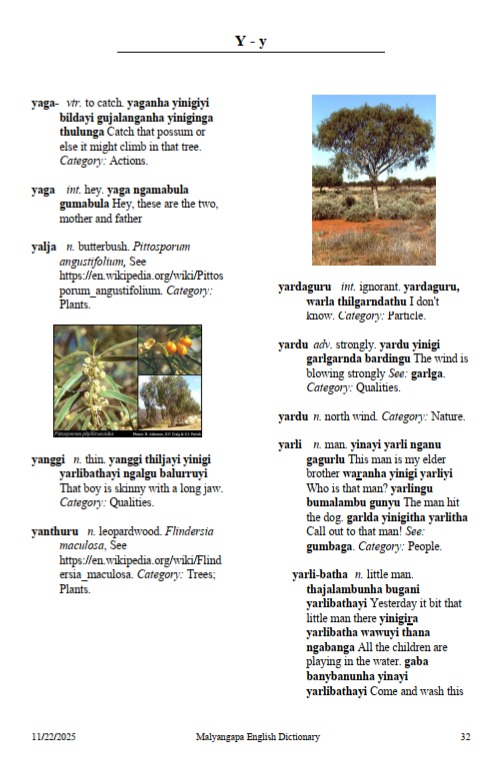
Malyangapa is relatively closely related to the neighbouring Wadikali and Yardliyawarra languages, sharing common vocabulary with them. Together the three languages form the Yarli group (Hercus & Austin 2004). There is limited data on Wadikali and Yardliyawarra, and in future we plan to include in our database all the information on them for comparative purposes. There are several items of vocabulary that are unique to the Yarli languages and not found in any of the neighbouring languages, such as gunyu ‘dog’, guduRu ‘black swan’, gumbuga ‘woman’, guma ‘father’, gula ‘one’, ngadjarra ‘camp’, and thitha- ‘to see, look’.
More broadly, Malyangapa shares an amount of vocabulary with languages of the Karnic group whose traditional territory lies to the west, such as Yandrruwandha and Diyari. For example, we find the following:
| English | Malyangapa | Diyari | Yandruwandha |
| bustard, wild turkey | karlathurra | karlathurra | |
| eaglehawk | karrawaRa | karrawaRa | karrawa |
| to flow | ngaga– | ngaka– | ngaka– |
| language | yawarra | yawarra | yawarri |
| to die | bali– | pali– | paldri– |
There are also words that are shared with Baagandji to the east of Malyangapa, but these tend to also be shared with languages to the west as well, such as:
| English | Malyangapa | Baagandji | Diyari | Yandruwandha | Adnyamathanha |
| possum | bilda | bilda | pildra | pildra | vilda |
| fat | marni | marni | marni | marni | marni |
| pigweed | birla | birla | virdla | ||
| boomerang | wana | wana | wana | wadna |
Note: Baagandji wana is ‘fighting boomerang of the non-returning kind’; Diyari wana is ‘digging stick’, mainly used by women.
A striking feature of pronunciation for Malyangapa and Wadigali is that consonants after the first vowel of a word are phonetically doubled and sound long, compared to consonants elsewhere in the word. This was apparent even to early recorders like Dewhurst (1886) who wrote “yalli” for yarli ‘person’, “umma” for ngama ‘mother’ (also ‘breast, milk’), “muttoo” for muthu ‘grass’, and “kappi” for gabi ‘egg’. This lengthening of consonants is shared with languages from Baagandji to as far west as the Flinder’s Ranges and those east of Kati Thanda Lake Eyre. In the western languages, a b or d sound can be inserted before the first consonant, in a process called “pre-stopping” — compare the Adnyamathana words for ‘pigweed’ and ‘boomerang’ in the table above. This insertion also occurs in Yardliyawarra, which has yardli ‘person’ (Malyangapa yarli), and gudnyu ‘dog’ (Malyangapa gunyu).
Sources of information on Malyangapa are:
- Austin, Peter K. 2002. Developing Interactive Knowledgebases for Australian Aboriginal Languages — Malyangapa. Paper presented at EMELD workshop, 2003. download
- Beckett, Jeremy & Luise Hercus. 2009a. The Two Rainbow Serpents Travelling: Mura Track Narratives from the ‘Corner Country’. Canberra: Australian National University Press. download
- Beckett, Jeremy & Luise Hercus. 2009b. Geographical names in the Two Ngatyi Stories. The Two Rainbow Serpents Travelling: Mura Track Narratives from the ‘Corner Country’. Canberra: Australian National University Press. download
- Dewhurst, A. 1886. No. 69. Evelyn Creek. In Edward Micklethwaite Curr (ed.) The Australian race: its origin, languages, customs, place of landing in Australia and the routes by which it spread itself over the continent. Volume 2, 156-157. Melbourne: John Ferrer, Government Printer.
- Hercus, Luise & Peter K. Austin. 2004. The Yarli Languages. In Claire Bowern & Harold Koch. (eds.) Australian Languages: Classification and the comparative method, 207-222. John Benjamins. download
- Morton, A. W. 1886. Near the North-west corner of New South Wales. In Edward Micklethwaite Curr (ed.) The Australian race: its origin, languages, customs, place of landing in Australia and the routes by which it spread itself over the continent. Volume 2, 158-161. Melbourne: John Ferrer, Government Printer.
- Reid, James A. 1886. Torrowotto. In Edward Micklethwaite Curr (ed.). The Australian race: its origin, languages, customs, place of landing in Australia and the routes by which it spread itself over the continent. Volume 2, 178-181. Melbourne: John Ferrer, Government Printer.
- Tindale, Norman Barnett. 1974. Maljangapa (NSW). Aboriginal Tribes of Australia: Their Terrain, Environmental Controls, Distribution, Limits, and Proper Names. Canberra: Australian National University Press.